The corporate training and learning and development (L&D) industry is entering a paradoxical moment. Demand for learning is high. Organisations are scrambling to upskill teams, adapt to ongoing AI developments and technologies, address burnout and facilitate leadership development. In a recent poll taken by People Management Insight, companies stated their top L&D priorities in 2026 and beyond are leadership development (50%), upskilling (17%) and developing AI literacy (14%).
Despite this appetite for learning, training providers are finding it harder than ever to cut through the noise. Markets are saturated and buyer attention is fragmented. Plus, the long, multi-stakeholder sales cycle typical of L&D means that even the most exceptional programmes can struggle to gain momentum.
In this uncertain environment, it’s understandable why you, as a training provider, might double down on familiar marketing tactics like more social media content or more webinars. These channels have their place. But you’re usually relying on the luck and fickleness of algorithms to get your programmes seen.
I believe a lead generation channel that’s overlooked and highly effective is podcast guesting. In this article, you’ll learn why being a guest on a podcast can build your training business and how to do it.
Why podcast guesting is a strategic lead generation channel for training providers
A long-form storytelling channel for building authority
Podcasts are a powerful medium for training providers because they allow you to do something that a lot of marketing channels don’t: they show you think authentically. The authentic part is key here because being interviewed in an audio medium like a podcast can be perceived as a natural conversation that doesn’t have to be polished or salesy. You’re still showing your professional expertise, but you don’t have to act like a ‘business version’ of yourself and be performative.
Showing how you think uniquely and authentically is more important than ever in a training provider industry saturated with generic promises of ‘transformation’ and ‘high performance.’ The long-form conversation of podcasts gives you the space to explain the why behind your approach, the how of your process and the stories that prove your impact.
All this can add up to building trust faster than written content.
Built-in warm distribution
Another benefit is being a podcast guest is that you’re tapping into a new network by being interviewed by a podcast host. In essence, you’re borrowing their audience and credibility, while proving your own expertise. This may be especially effective on podcasts with large followings because you are being positioned as credible by a third party.
You also build a connection with the host, which may lead to other collaboration opportunities.
High signal, low noise
Consider these podcast listening stats:
70% of people living in the US and 69% of people living in the UK have listened to a podcast at least once. - The Podcast Host
17% of podcast listeners are early adopters of new products. - Statista
83% of senior executives listen to a podcast weekly and 68% of consumers are more willing to consider a service after hearing about it on a podcast. - Lower Street
Three quarters of podcast listeners say they listen to between 1 - 5 podcasts per week, while 1 in 10 regular podcast listeners actively subscribe to 11 or more podcasts. - Ofcom
These stats highlight that podcast listeners are self-selecting and highly engaged when it comes to the topics they want to learn more about. A large majority of key decision makers within businesses listen to podcasts that align with their values and may want to test drive a product or service.
This means that as a podcast guest, you have a direct line to showing why your training programme matters to the organisations you want to help, and the competition is lower compared to trying to get attention on social media.
Evergreen content and multi-channel repurposing
You can also look at podcast guesting as an always-on sales asset. Your interview will be archived in Spotify, Apple and other podcast hosting platforms. Listeners may find you months or years after the episode has been recorded and turn into inbound leads.
There’s also the opportunity to repurpose podcast episodes into content for different channels such as:
Podcast clips and sound bites into LinkedIn social posts for your programme launch.
Quotes and takeaways into email nurture sequences to help with implementing workshop materials.
Episode transcripts into educational articles featured on your L&D platform.
How training providers can build an effective podcast guesting strategy
Now that we’ve looked at the benefits of podcast guesting, here’s how you can develop a strategy for growing your training business under a model I like to call the Three Ps of Podcast Guesting - Planning, Precision and Pitching.
Step 1: Planning
Define your goals
The first thing you want to do is think about your podcast guesting goals. It’s important you set realistic expectations for what you want to achieve with your outcomes. I find it helpful to look at two levels of desired outcomes:
Baseline outcome: The minimum positive result that makes appearing on a podcast worthwhile.
Ideal outcome: The high-value result that would make the appearance game-changing for your business.
These outcomes aren’t and/or. They are two sides of the same coin. To help you clarify them, here’s a list of questions to ask yourself and example results.
What’s the core message I want listeners to walk away with?
Baseline: Listeners understand who I help and the problem I solve.
Ideal: Listeners adopt my unique methodology as the ‘missing piece’ they’ve been looking for.
What business goal am I trying to support through this appearance?
Baseline: Increased visibility and brand awareness.
Ideal: A measurable influx of qualified leads or invitations to speak/teach.
Who exactly do I want to reach?
Baseline: Listeners broadly aligned with my niche e.g. HR and wellbeing professionals.
Ideal: Highly-aligned decision makers who are actively exploring training programmes like mine.
What is the simplest call to action I want people to take?
Baseline: They follow my social profiles or visit my website.
Ideal: They download something high-value e.g. a cheatsheet or book a free consultation.
What part of my story is most relevant to this audience?
Baseline: I explain my story clearly and concisely.
Ideal: I share a story that reframes the problem and positions me as the guide they’ve been waiting for.
Which of my frameworks or ideas translates best into audio and video?
Baseline: I explain my key ideas in ways that are understandable or practical.
Ideal: I dismantle a major objection in a way that dramatically shortens future sales cycles.
What emotional impact do I want to create?
Baseline: The audience feels informed and trusts my expertise.
Ideal: The audience feels inspired and motivated to take the next step with me.
How will I measure success after my episode is live?
Baseline: An increase in followers or website traffic.
Ideal: New clients citing the episode or deeper engagement from my existing audience.
How will I repurpose the episode once it’s live?
Baseline: I share it on LinkedIn or email my newsletter followers the link.
Ideal: I turn it into weeks of content, clips, nurture emails and sales collateral.
What differentiates my voice in this conversation compared to others in my space?
Baseline: I articulate my niche clearly.
Ideal: My positioning is so distinct the host and audience see me as the go-to expert for that specific problem.
What is the single most valuable insight I can give to the host’s audience?
Baseline: I give practical advice they can use right away.
Ideal: I deliver a mindset or model shift that changes how they think about the entire problem.
Define your positioning
Once you’ve asked yourself these goal-focused questions and written down your baseline and ideal outcomes, it’s time to think about your positioning.
Many of the goal questions should help you articulate your positioning in a raw format. As for expressing it with authority, a media bio often comes in handy.
A media bio is a one or two-page document that shares your story and expertise quickly and impactfully. It should demonstrate to a podcast host why you are a must-listen to guest.
Here are guidelines for how you can write your media bio:
Introduction
One to three paragraphs explaining who you are, what kind of training or coaching programme you provide and your unique perspective.
Accolades/Credibility section
Feature a section of any clients you’ve helped, specific results of collaborations.
Specialisms to comment on:
List a number of topics you feel confident talking about.
Episode titles:
Come up with a list of ready-made episode titles and angles linked to your topics. Having topics and episode angles in mind already takes a lot of pressure off podcast hosts when you pitch them.
Step 2: Precision
Compile a list of podcasts in your niche
After you’ve articulated your positioning, start researching podcasts that are linked to your training specialism.
Searching Google is a good first step. To get more specific, you can research podcast directories that feature podcast hosts actively looking for guests or podcasts listed with basic data points of host name and contact information.
Here are several directories to get you started. Some are free, while others are pay-to-play.
Feedspot is a great directory for finding basic information about the name of a podcast and the name of a host. Often, Feedspot features ‘top x podcasts in [industry] and [country]’ lists, making it easy to find a training provider podcast in a specific country.
Player FM is a free podcast directory. Like Feedspot, it has a ‘best [podcast topic] list’ feature that makes finding podcasts related to your niche simple. My favourite feature is that it shows how recently a podcast episode was recorded e.g. it might say ‘1 day ago’ or ‘6 hours ago.’
This feature is useful for your research because it indicates how active a podcast is. You won’t waste time pitching shows that haven’t released a new episode in years!
Podwatch is interesting because it has a chart feature that regularly updates to showcase the popularity and relevance of a podcast within its Apple topic category.
Podcasts in the Podwatch chart are always moving up and down. Some of this data is free to access and can be useful for benchmarking how popular a podcast is in terms of listenership and downloads.
Podmatch acts as a matchmaker for podcast hosts and guests. You can make a profile that features your story and expertise and actively pitch hosts on the platform. To use Podmatch it’s $32 per month on the basic package.
Podcast Guests is another subscription-based matchmaker, with the cheapest monthly package being $15.
A great free feature to take advantage of is to sign up to the newsletter. Hosts looking for guests are featured weekly, while buying a subscription offers premier placement as a guest.
Step 3: Pitching
Use the P.I.T.C.H framework
The final step is to start reaching out to your selected podcasts through email. You may find this pitching framework of mine useful for writing an email that hooks the interest of a host:
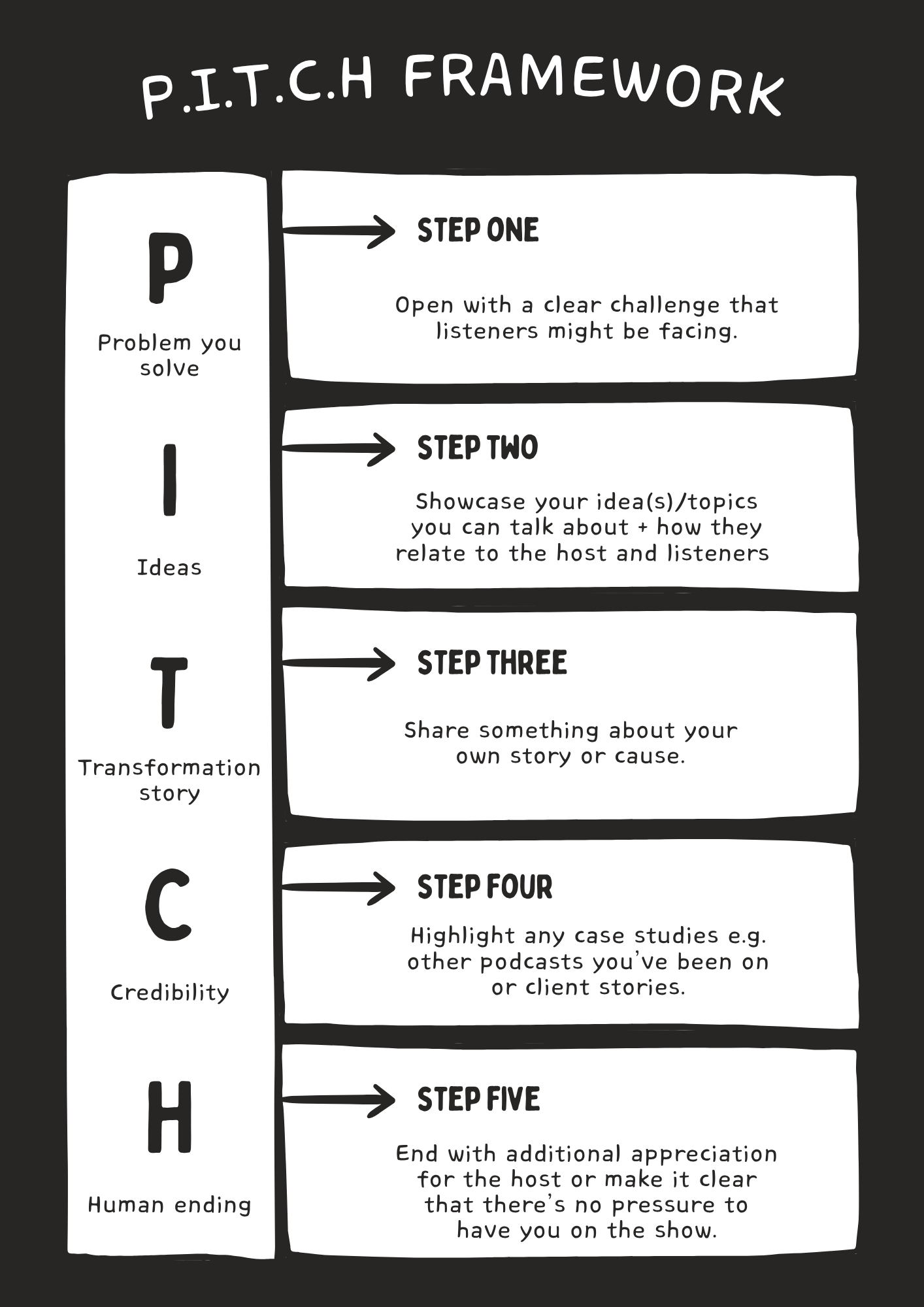
P - Problem you solve: Open with a clear challenge that listeners might be facing.
I - Ideas: Showcase your ideas/topics you can talk about and how they relate to the host and listeners.
T - Transformation story: Share something about your own story or cause.
C - Credibility: Highlight any case studies e.g. other podcasts you’ve been on or client stories.
H - Human ending: Finish your email with additional appreciation for the host or make it clear that there’s no pressure to have you on the show.
The pitching stage is also a good time to revisit your media bio and update it based on any particular topics you think might resonate with a specific podcast. Attach the media bio with your email, and away you go.
Podcast guesting done for you and with you
When done strategically, podcast guesting can be the hidden advantage to boosting awareness of your training programme and gaining new leads. The tools I’ve laid out in this article will give you a head start in defining your strategy and pitching to shows that align with your mission.
Of course, the DIY approach may not be right for you if you’re juggling multiple responsibilities and only want to focus on course and programme delivery.
Book a free ideas call to explore podcast guesting opportunities with Spotlight Training Co, and we’ll set you up for success.