When it comes to translating training or L&D practices into a real world setting that produces impact, it’s helpful to look at perspectives rooted in pop culture.
Now, pop culture can mean many things to many people, but the common thread that links all shows, games and fandoms together is that complicated information can be turned into knowledge that a person understands. Profound lessons can be learnt without someone even realising they are learning in a medium that’s presented as entertainment. This is a foundation for passive knowledge being turned into actionable wisdom.
L&D practitioners are seeing the usefulness of pop culture perspectives in their work. For example, Adam Kupka, an instructional design specialist believes Dungeons and Dragons offers invaluable frameworks for designing training programmes. Dr Kevin Thorn uses comics, animation and a framework called LEGO® SERIOUS PLAY® to develop innovative training solutions.
Another fandom you should absolutely take inspiration from is Warhammer 40,000.
Why Warhammer 40,000 Is A Powerful Lens For Designing Training Programmes That Show Real Impact
Warhammer 40k is a grimdark sci-fi universe that covers table top gaming, books and video games. Humans living in the Imperium are fighting a never-ending war in the distant future in the name of the God-Emperor. Alien threats, demonic forces and countless other horrors make the 40K universe a violent and uncompromising place.
Here is the starting point for understanding why Warhammer 40k offers a strong lens into thinking about impact-driven learning and training design. It’s a setting built around institutions that are being forced to survive under extreme pressure. Every faction has to solve core challenges that trainers and L&D professionals often come up against on small and large scales. Situations like selecting people who are ready to lead, shaping behaviour under stress, preserving knowledge and building relationships in a crisis are all part and parcel of the experience.
The Warhammer 40K universe is over the top and exaggerated, which makes it easier to analyse and understand from an L&D perspective. You can see extreme consequences of what happens when a culture is weak and when behavioural change produces life and death outcomes. In this batshit crazy sci-fi setting the feedback loops are visible where in corporate life, they are hidden by politics or complex policies.
For a learning designer focused on impact rather than smile sheets, this perspective is liberating. It moves the attention away from event design and into developmental architecture where you need to know whether a programme changes how participants feel about themselves and how they act when the pressure is real.
Warhammer works because it strips L&D down to the fundamentals through the lens of saying there can be no room for performative measures and survival is the number one priority.
The Imperium Of Man has endured for thousands of years because of its all-or-nothing approach to fulfilling the will of the God-Emperor. The Imperium is infamously rigid in its dogma and that stagnation is part of the narrative tension. Yet, even within its vast bureaucracy, the factions that stay effective over millennia are those that have kept an internal coherence around how they select, test, mentor and bind their members together.
In the real world, training has to be flexible and responsive to changing markets, technologies and expectations. At the same time, programmes that have a lasting impact are linked by selection, meaningful challenge, guided experience, shared identity and cultural storytelling.
A faction to study for how all of this works and for actionable takeaways is the Space Wolves.
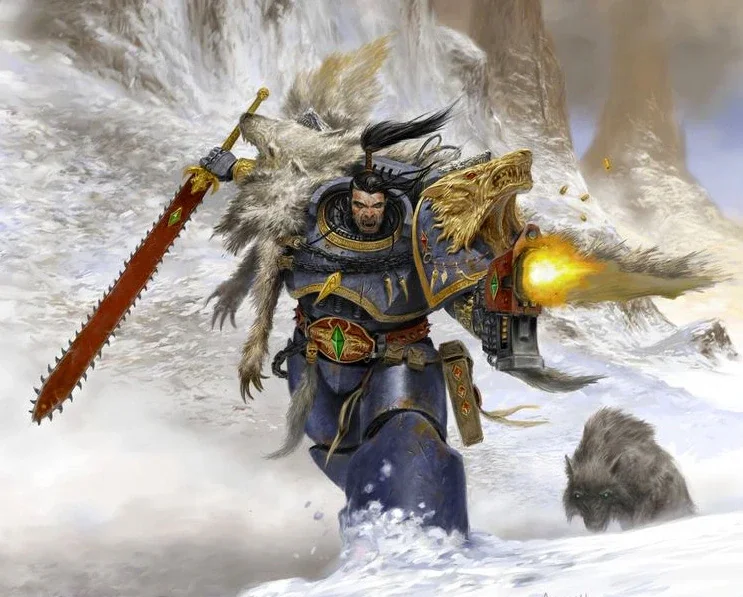
Ragnar Blackmane is one of the most famous Space Wolves in the Warhammer 40,000.
Culture As The Foundation For Capability
The Space Wolves are a chapter of the Space Marine faction, the poster group for Warhammer 40,000. The Space Wolves are essentially vikings in space with a lot of their traditions and aesthetics taken from old Norse cultures.
They recruit their members on Fenris, a brutal icy world where survival demands resilience long before any Space Marine training begins. By the time an aspirant has been identified, he has already been shaped by an environment that rewards courage, adaptability and loyalty to his tribe.
Training doesn’t create these traits from scratch. Rather, it builds on them and expects a high level of detail. In a lot of companies, learning is treated as an intervention mapped onto a neutral culture when culture in itself is never neutral or passive.
Culture is always conditioning behaviour and if the surrounding environment discourages risk taking or punishes honest feedback, no leadership programme will ever fully compensate. The Space Wolves illustrate that development works best when the wider system already reinforces the behaviours you want to see.
For L&D folks, this invites reflection on what happens between workshops and what stories and experiences happen in the weeks after skills are expected to be embedded. Remember that capability isn’t the product of a specific curriculum or programme. Capability grows in systems where expectations and rituals align with the lessons being taught.
Readiness And The Psychology Of Commitment
Once an aspirant has been chosen for the Space Wolves, he goes through trials that test his endurance and resolve. He’s given a volatile gene called the Canis Helix and left out alone in the wilderness of Fenris to see if his body is able to survive the transformation. All the tests the aspirant faces are meant to create a psychological crossing point, the certainty of a chosen path that will be permanent.
In corporate learning, participation might be mandatory if senior leaders are introducing a training programme as a tick box exercise. But if a trainer can make a meaningful case to managers who shape decisions within their teams and create a sense of autonomy for learners, then this can make a difference. Research on motivation consistently shows that autonomy increases persistence and a likelihood to commit to an action. The Space Wolves reflect this principle through ritualised selection.
Ordeal And Adaptive Growth
The transformation of a baseline human into a Space Wolf through the Canis Helix is symbolic as well as physical. Growth involves instability and there’s a period where an old identity breaks down before the new one stabilises.
In some modern learning programmes, discomfort may be minimised and sessions controlled so precisely that outcomes are predictable and only show activity rather than impact. The truth is that human systems adapt through challenge and cognitive growth involves wrestling with ambiguity.
This means learning designers should create programmes with real stakes or live business challenges that encourage growth through adaptation. The aim doesn’t have to be to add unnecessary pressure when a learning objective is getting someone to meaningfully engage with a real dilemma and integrate new knowledge that will be retained and applied.
Identity Formation And Social Encoding
A new Space Wolf, called a Blood Claw, is assigned to a pack once they’ve survived their trials. Once the Blood Claw joins a pack, their identity is no longer individualistic and becomes collective. The pack shapes how he interprets events, responds to threats, measures success, judges his value and weighs the consequences of his decisions.
Social identity theory tells us that people align behaviour with the norms of groups they value. When development programmes create a strong cohort bond, they tap into this dynamic and participants begin to see themselves as part of a community with shared standards.
Simple practices to encourage this sense of shared identity might include naming cohorts, celebrating new members or creating alumni groups that reinforce connections. The goal is always for individuals to internalise a new perception of self within a group. Skills matter, but the stories people tell about who they are matters more.
Story As A Vehicle For Knowledge Transmission
The culture of the Space Wolves revolves around sagas. These are stories of the Legion’s victories, failures, personal trials, exceptional heroes who honoured their brothers and enemies slaughtered in battle. What’s most important about the sagas is they carry tactical lessons and moral expectations of how packs are meant to conduct themselves.
Neuroscience supports what ancient and space viking cultures have intuited: stories organise information in ways that are easier to remember and retrieve. They attach emotion to perspective, strengthening memory consolidation.
In many companies, knowledge can be static. It sits in a draw gathering dust or it’s never revisited once a workshop delivering specific skills has finished.
A remedy for this is to encourage leaders and teams to share lived experiences of important projects. When someone recounts how a decision was made under pressure, listeners gain context and nuance about judgment. Therefore, structured storytelling in learning programmes can create a bank of shared experience that guides future action.
Autonomy Within A Coherent Framework
Despite their strong collective identity, Space Wolves operate with considerable autonomy in the field. They don’t follow the traditional codes of conduct by other Space Marines and in a Dungeons and Dragons context they might be considered chaotic good for their approach to battle. All packs make tactical decisions based on local conditions while staying aligned with an overarching mission and values.
This balance between freedom and logic is instructive. Adult learners respond well to autonomy and when given space to apply principles in their own context, they learn more effectively. A training initiative that’s too rigid can limit the process of learning being turned into behaviour change. Giving options within a clear strategic framework lets learners connect development to specific responsibilities.
Designing Development As Initiation And Guarding Against Rigidity
There’s no denying that a strong culture creates cohesion. But if it’s left unchecked and new ideas and perspectives aren’t introduced, culture stagnates or becomes insular. Ritual and tradition should be constantly checked in a company to make sure that they are still relevant.
Still, it’s worth viewing all these takeaways from the culture of the Space Wolves as a whole. They suggest a way of thinking about L&D as initiation into a supportive community that values personal and collective identity. Learners enter through a meaningful threshold, encounter structured challenges, receive guidance from experienced mentors and emerge with a transformed sense of self.
This arc parallels the journey of a Space Wolf from a tribal survivor to a seasoned warrior bellowing Fenrys hjølda on a battlefield as they take on armies of aliens and Chaos worshippers with their brothers at their side.
There doesn’t have to be any theatrics with translating these relevant aspects and ideas into learning design. All it requires is intentional design that recognises the human need for belonging, growth through challenge and stories that reinforce meaning and purpose. Warhammer 40K has all of that in spades and when L&D is approached in this way, it becomes a part of a company’s DNA, not a series of isolated events.